 Stock Market
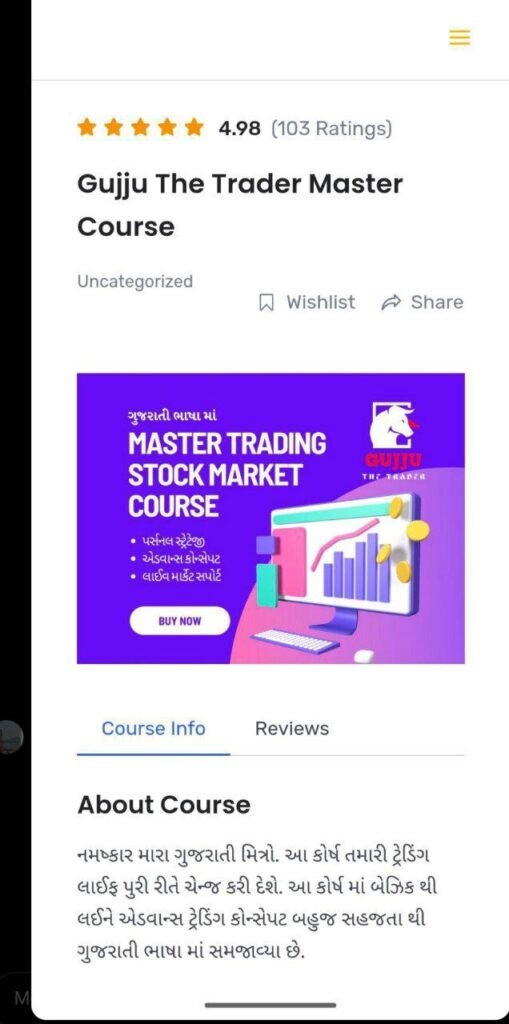
Gujju The Trader Master Course – Basic to Advanced Trading
₹199.00
Learn the Gujju The Trader Master Course covering technical analysis, trading strategies, Bank Nifty, risk management, psychology, candlesticks, and chart patterns.
- Instant access after purchase
- 7-day money-back guarantee
- Support from real humans
Product Description
Gujju The Trader Master Course – Basic to Advanced Trading
The Gujju The Trader Master Course is a trading education program designed for students who want to learn stock market trading in Gujarati. The course covers concepts from basic to advanced levels and focuses on understanding the logic behind trading strategies. The publicly listed course is presented as a Gujarati-language trading program.
What Is the Gujju The Trader Master Course?
The Gujju The Trader Master Course teaches a structured approach to understanding financial markets. The official Gujju The Trader platform covers stock market basics, technical analysis, futures and options, money management, trading psychology, scalping, and intraday trading.
The course is designed to help students understand trading concepts rather than simply follow random market calls.
What You Can Learn
Stock Market Basics
Understand fundamental stock market terminology and learn how financial markets work. A strong foundation can make advanced trading concepts easier to understand.
Technical Analysis
Learn how traders use charts and technical tools to study price movement. The publicly listed curriculum includes concepts such as candlesticks, chart patterns, support and resistance, and technical indicators.
Trading Strategies
Explore different trading concepts and strategies. The official course information references approaches involving RSI, EMA, Bank Nifty, gap trading, Fibonacci, and intraday trading.
Bank Nifty Trading
Learn concepts related to Bank Nifty and short-term market analysis. Bank Nifty strategies are included among the topics publicly associated with Gujju The Trader’s educational material.
Risk and Money Management
Risk management is an important part of trading. Learn why position sizing and controlled risk matter when developing a trading plan.
Trading Psychology
Trading decisions can be affected by emotions. The course material addresses trading psychology and controlling over-trading as part of the learning process.
Candlesticks and Chart Patterns
Learn how candlestick formations and chart patterns can be used as part of technical analysis. These concepts can help traders interpret price behavior and market structure.
Who Is This Course For?
The Gujju The Trader Master Course can be useful for people who prefer learning trading concepts in Gujarati.
It may be suitable for:
- Beginners learning stock market basics
- Gujarati-speaking traders
- Intraday traders
- Bank Nifty traders
- Technical analysis learners
- Traders studying price action
- Students learning risk management
- Existing traders improving their trading process
Why Learn Trading in Gujarati?
Learning complex concepts in a familiar language can make the material easier to understand. Gujju The Trader focuses on providing stock market and trading education in Gujarati. Its public educational material covers both beginner and advanced trading topics.
A structured learning process can help students understand the reasoning behind a strategy instead of relying only on trade calls.
Course Information
Course Name: Gujju The Trader Master Course
Instructor/Brand: Gujju The Trader
Language: Gujarati
Level: Basic to Advanced
Course Type: Trading Education
Topics: Technical Analysis, Intraday Trading, Bank Nifty, Risk Management, Trading Psychology
Public course material also describes the program as covering basic-to-advanced topics and providing lifetime course access with additional student support in its published course information.
Important Trading Risk Disclaimer
Trading financial markets involves significant risk. Educational material does not guarantee profits. Trading strategies can produce losses, especially when leverage or derivatives are involved. Always conduct your own research and use appropriate risk management.